Busting the Myth Around Ghostwriters
Busting the Myth Around Ghostwriters: What Ghostwriters Actually Do
I didn't think I was a ghostwriter. When I started my business, I struggled (and still do) to define exactly what I do.
I've landed on "Content Strategist" because it's broad enough to cover the mix of writing, planning, editing, and content-related work I provide to clients.
But recently, I've noticed more conversations about ghostwriting.
Maybe it's because AI has made content creation easier than ever. Maybe it's because professionals are investing more heavily in personal branding and thought leadership. Whatever the reason, the term seems to be everywhere.
So I got curious. I did some research.
And I realized something surprising: I've been ghostwriting for years.
What I thought a ghostwriter was
For whatever reason, I filed "ghostwriter" under a very specific category.
Celebrity memoirs.
Political speeches.
Historical figures hunched over a desk with a quill pen, quietly producing work for someone else while remaining anonymous.
It felt like a niche profession practiced by a small group of mysterious specialists.
Apparently not.
The myth, at least in my mind, was that ghostwriters were these behind-the-scenes professionals quietly writing books and speeches for famous people.
The reality is much less mysterious.
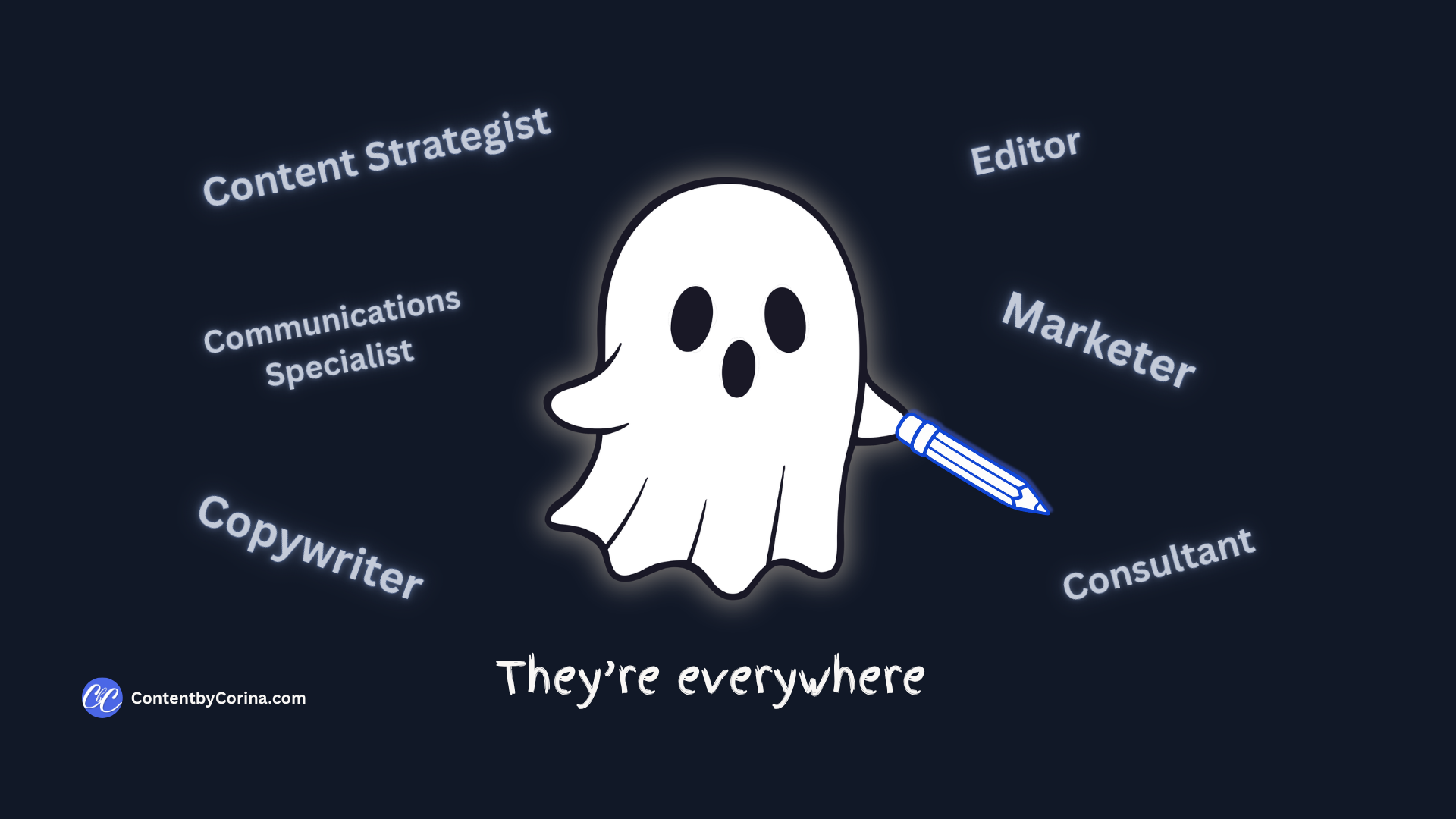
Many writers, marketers, consultants, and content professionals are performing ghostwriting work every day. They just happen to use different job titles.
What ghostwriting actually is
Curious, I pulled out my hardcopy Merriam-Webster dictionary.
The entry for ghostwrite reads: "to write for and in the name of another."
In layman's terms, a ghostwriter is someone hired to write content that is ultimately published under someone else's name.
That's it.
Once I stripped away the mythology surrounding the term, I started seeing ghostwriting everywhere.
The consultant writing LinkedIn articles for an executive.
The copywriter creating website content for a business.
The marketer drafting email newsletters.
The communications professional preparing thought leadership content.
Many of these professionals may not call themselves ghostwriters. But they're performing ghostwriting tasks every day.
A ghostwriter isn't pretending to be the expert
One misconception I had was that ghostwriters somehow replace the expertise of the person they're writing for. In reality, it's usually the opposite.
The attorney still understands the law.
The doctor still understands medicine.
The executive still understands their business.
The consultant still understands their industry.
The ghostwriter's job is to help communicate that expertise clearly, consistently, and in a way that's accessible to the intended audience.
The expertise belongs to the subject matter expert.
The writing belongs to the writer.
→ Good ghostwriting brings the two together.
Why businesses hire ghostwriters
For businesses, the answer is usually straightforward.
As a company grows, so does the amount of content required to support it.
Websites need updating. Newsletters need writing. Social media accounts need attention. Blog posts need publishing.
Even if the owner is an excellent writer, there eventually aren't enough hours in the day to do everything personally.
Hiring a ghostwriter allows the business to maintain a consistent voice and presence without requiring leadership to spend their days creating content.
In that sense, a ghostwriter isn't replacing expertise. They're helping scale communication.
Why individuals hire ghostwriters
This is where the conversation becomes more interesting.
When people hear that an executive, attorney, consultant, or business owner uses a ghostwriter, there's sometimes an immediate reaction: "Wait, so they didn't actually write that?"
Technically, perhaps not.
But that doesn't mean the ideas aren't theirs.
The best ghostwriting relationships are highly collaborative.
The subject matter expert brings the expertise, opinions, experiences, and perspective. The writer helps shape those ideas into content that is clear, organized, and engaging.
In many cases, the ghostwriter is less of a substitute and more of a translator.
They're translating years of experience into content other people can consume.
The final article may take the writer several hours to draft. The expertise behind it may represent decades of experience.
That's why I've become less skeptical of ghostwriting the more I've learned about it.
For many professionals, hiring a ghostwriter isn't about pretending to be something they're not. It's an investment in communicating what they already know.
The quality of the final content still depends on their involvement, feedback, and approval. A ghostwriter can help organize and articulate ideas, but they can't manufacture expertise that doesn't exist.

Not all ghostwriting looks the same
While researching ghostwriting, I quickly learned that the title doesn't tell you much about the service itself. Two people may both call themselves ghostwriters while offering completely different levels of support.
At one end of the spectrum is a writer who takes direction and turns it into polished content.
At the other end is someone who helps identify topics, interview subject matter experts, develop content strategies, create supporting visuals, optimize content for search and AI discovery, and repurpose ideas across multiple platforms.
Neither approach is inherently better. They're simply different services.
The important question isn't whether someone is a ghostwriter.
It's what role they're playing in the content creation process.
Are they helping organize your ideas?
Developing the strategy?
Creating the content?
Designing supporting visuals?
Managing distribution?
Or some combination of all of the above?
The answer often has a greater impact on the final result than the title itself.
For example, many thought leadership pieces today are accompanied by custom illustrations, diagrams, infographics, videos, or document-style presentations. These assets help reinforce the ideas being shared and give the content a longer shelf life across multiple platforms. In those situations, the value being provided extends well beyond writing alone.
The ghostwriter may be helping build an entire collection of content and supporting collateral around a person's expertise rather than simply drafting an article.
The thing that surprised me most
The biggest surprise wasn't learning what ghostwriting is.
It was realizing how common it is.
Ghostwriting isn't a secret profession hiding in the shadows.
It's a skill used every day by writers, marketers, content strategists, copywriters, communications professionals, and consultants.
Many of us are doing ghostwriting work whether we use that label or not.
Turns out, I was one of them.
True story. Myth busted.
